

(Middle photo above by Evan Vucci, AP) This work is for educational purposes only. It is intended to facilitate critical thinking, commentary, and analysis of the subject matter. The use of copyrighted material is governed by the doctrine of fair use (17 U.S.C. § 107), which permits limited use of copyrighted material without obtaining permission from the copyright holder. The copyrighted material is used solely for the purpose of criticism, commentary, news reporting, teaching, scholarship, or research, and is not intended to infringe on the copyright holder’s exclusive rights. If you are the copyright holder and wish to have the material removed, please contact the author of this blog.
Before we begin, we hope that Donald Trump and his family are healthy and well. We condemn violence against presidential candidates.
The Symbols on the Flag: What Do They Represent?
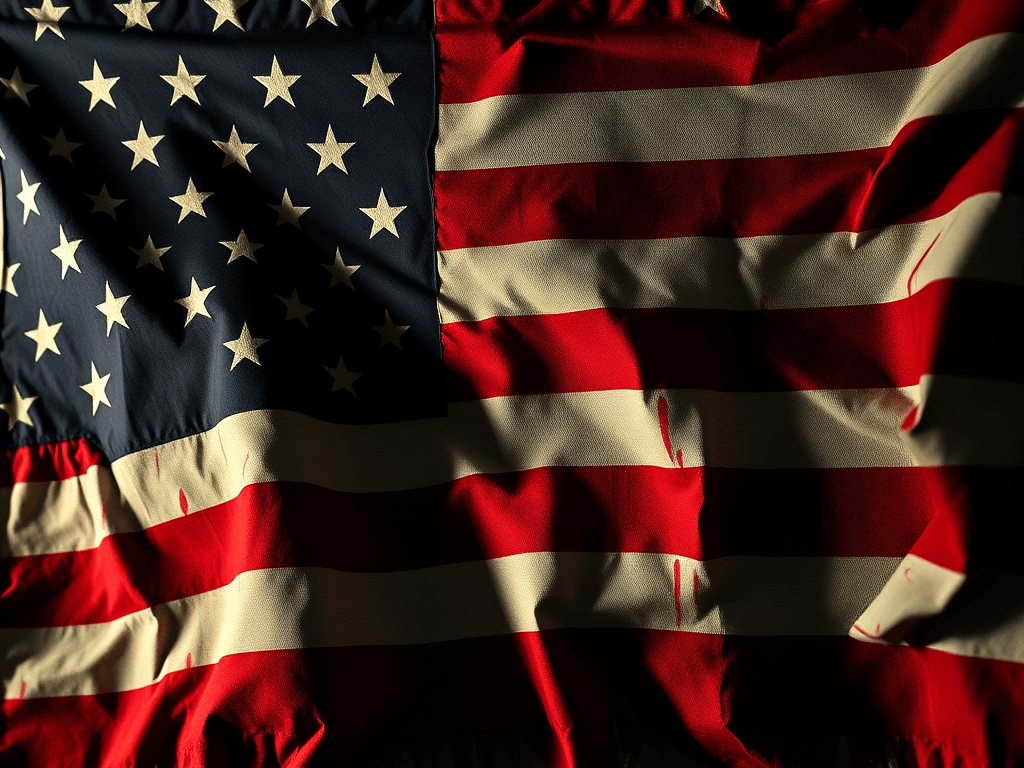
The American flag is a powerful symbol, but have we ever truly reflected on what its elements represent? The 13 stripes on the flag are said to symbolize the original 13 colonies, and the stars represent the 50 states. But what about the colors? White signifies purity and innocence, blue represents vigilance, perseverance, and justice, and red stands for valor and bravery. But could it also stand for the bloodshed that has become intertwined with America’s identity?
Yesterday, an assassination attempt was made on former President and current presidential candidate Donald Trump at one of his campaign rallies in Pennsylvania. This event occurred just before the Republican National Convention, where he is expected to announce his vice-presidential running mate. The photo taken during the attempt by AP photojournalist Evan Vucci was striking: lines of blood on Trump’s face echoed the red stripes on the American flag, drawing an eerie parallel between the imagery of violence and the very symbols of our nation.
America’s Relationship with Guns: A Grim Reality
In recent years, America’s relationship with guns and violence has come under increasing scrutiny. Compared to other developed nations, the U.S. has an alarmingly high murder rate, much of it gun-related. According to the Centers for Disease Control and Prevention (CDC), in 2020 alone, there were over 45,000 gun-related deaths in the United States, making firearms the leading cause of death for children and adolescents that year. This is starkly contrasted with countries like the United Kingdom and Japan, where annual gun-related deaths typically number in the tens rather than the tens of thousands.
The U.S. gun homicide rate is nearly 25 times higher than that of other high-income countries. A 2019 study published in The American Journal of Medicine found that while the U.S. accounts for just 4% of the world’s population, it accounts for 35% of global firearm suicides and 9% of global firearm homicides. This obsession with firearms and the resulting violence seem at odds with the ideals of purity and justice that the flag’s colors are supposed to represent.
Moreover, the Gun Violence Archive reports that in 2023 alone, there were over 600 mass shootings in the United States, defined as incidents where four or more people were shot. These statistics paint a troubling picture of a nation grappling with a deep-seated issue of gun violence, a stark contrast to the values of peace and justice that the American flag is meant to symbolize.
As we reflect on the red stripes of our flag, symbolizing valor and bravery, we must ask ourselves if this valor has been misinterpreted. Has our nation’s historical and cultural valor transformed into a justification for widespread violence? The red, once a symbol of sacrifice for freedom and justice, now seems tainted with the bloodshed of innocent lives lost to an unchecked gun culture.
America’s Foreign Interference: Spreading Bloodshed Abroad
America’s legacy of violence isn’t confined within its borders — no sir and ma’am. Throughout history, the U.S. has frequently interfered in the affairs of other nations, often under the guise of protecting its “interests.” From Vietnam to Iraq, and countless interventions in Latin America and the Middle East, these actions have often led to devastating consequences, leaving trails of bloodshed and instability in their wake. The red stripes on our flag could also symbolize the lives lost and the chaos wrought by these interventions. As we reflect on our national identity, we must ask: Is this the legacy we want to continue? Is it time to redefine our role on the global stage, moving from a nation of intervention to one of peace and cooperation?
Resisting American Interference: The Case of Cuba and Haiti
Some nations, like Cuba, have long balked at America’s interference in their domestic affairs, viewing it as a form of neocolonialism that undermines their sovereignty. Cuba’s resistance to U.S. influence is well-documented, from the Bay of Pigs invasion to the decades-long embargo that still affects the island nation. Haiti offers another poignant example of the detrimental effects of American intervention. Following the 2010 earthquake, the U.S. led a massive international aid effort, yet the country remains plagued by instability and poverty. Critics argue that the heavy-handed approach of the U.S. and its allies, including a history of military interventions and political meddling, has often exacerbated Haiti’s problems rather than solving them. These examples illustrate the complex and often harmful consequences of America’s attempts to exert control over other nations, raising questions about whether such interventions truly serve the interests of the people in those countries.
Historical Context: A Nation Born from Bloodshed
America’s history is deeply rooted in conflict and violence. The country was established when the UK emptied its jails, sending convicts to the New World. This violent genesis has left an indelible mark on the nation’s culture and psyche. Our history books glorify the bloody battles of the Revolutionary War, the Civil War, and numerous other conflicts. The red stripes on our flag could be seen as a reflection of this violent past and present.
Redefining Ourselves and What We Stand For
As we look at the blood-streaked face of Donald Trump in that photograph, eerily mirroring the stripes of our flag, we must ask ourselves: Is this what America truly represents? Are we a nation defined by violence and bloodshed? Perhaps it is time to think about redesigning our flag, not just in terms of its physical appearance, but in terms of what it symbolizes about our identity and values.
Inviting Reflection and Discussion
What do you think? Should we consider redesigning the American flag to better reflect our current values and aspirations? Is it time to redefine what we stand for as a nation? How did a gunman get so close to a former president? Share your thoughts and join the conversation. Let’s dare to envision a future where our symbols inspire unity, peace, and progress, rather than echoing a past marred by violence and division. Yes, we are supposedly free. Yes, we have a lot of stuff, but at what cost?
Feel free to leave your comments and let us know your perspective on this pressing issue.
Bibliography
- Centers for Disease Control and Prevention (CDC). “Firearm Mortality by State.” CDC Website.
- American Journal of Medicine. “Gun Violence in the United States and Worldwide.” Published in 2019. American Journal of Medicine Website.
- Gun Violence Archive. “Mass Shootings in 2023.” Gun Violence Archive Website.
- Brown University Costs of War Project. “Human Cost of Post-9/11 Wars: Lethality and the Need for Transparency.” Costs of War Project Website.
- Congressional Research Service. “American War and Military Operations Casualties: Lists and Statistics.” CRS Website.

