
This post is for those of us who came from the church pews but found our home at the foot of the Orisha. It’s about the shift from a faith of “grace” to a walk of intentional action.
The Man Who Shared His Chicken
I recently saw a social media post that stayed with me. A man talked about how, every single day, he would share a piece of whatever he was eating—even if it was just his last piece of chicken—with Eshu. It was a small, quiet Adimú. Then, life got busy. He stopped. Slowly, his roads began to close. Opportunities dried up, and the “static” of life became overwhelming.
When he realized what had happened and began to offer that small portion again, the gates swung back open. Eshu Elegbara once again led him through the portals of his own life. This is the power of the Adimú. Do not sleep on it, no matter what path you follow.
From “Faith & Grace” to the Kitchen
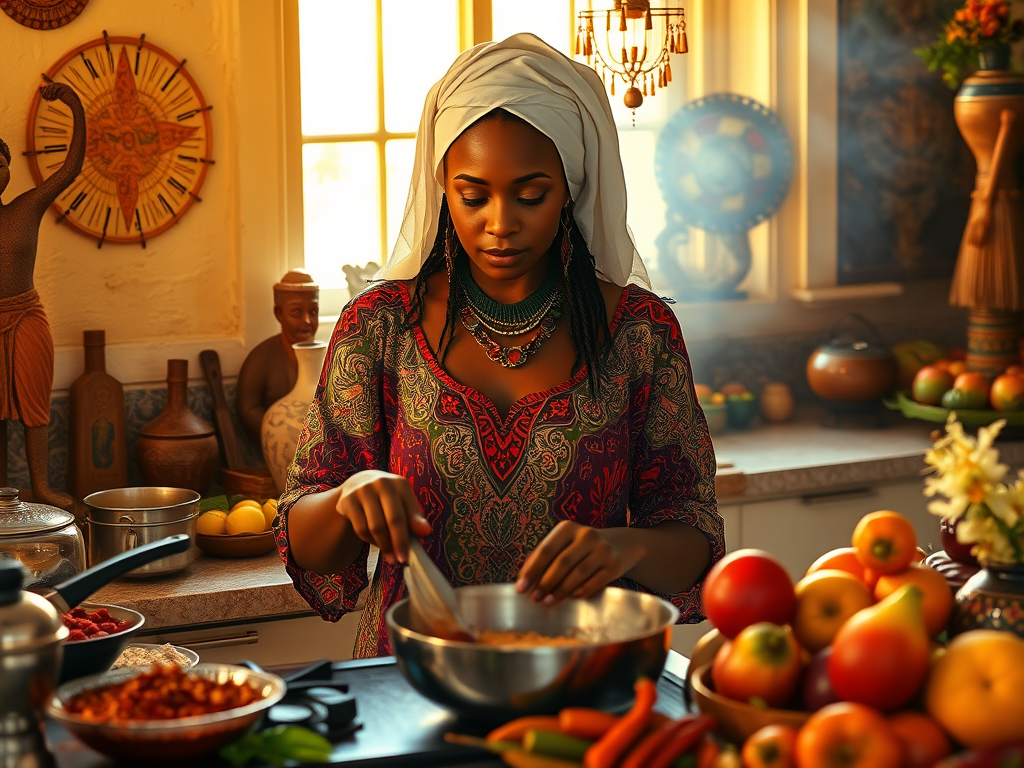
Coming from a Christian background, the idea of Adimú—offering food to the Divine—felt completely foreign. In the church, we were taught about grace and faith; it was all internal and etéreo. There was no place in my mind to understand the image of a Santera standing over a stove, seasoning a dish for a spirit.
Even though the Hebrews sacrificed food to Yahweh, Christians were taught that this is pure idolatry. We were told not to even think about doing it. As a result, many of us suffered and lacked.
I knew this Yoruba religion saved lives, but I didn’t understand the mechanisms. It wasn’t until I stepped into the kitchen myself that I saw the beauty. It isn’t just “cooking.” It is a devotional architecture that includes:
- Cleaning the Home: You don’t bring an Orisha into a cluttered dirty space.
- Cleaning Yourself: You approach the stove with a scrubbed body, soul and a clear mind.
- The Dress: You clothe yourself in respect before you even touch the ingredients or utensils.
- The Specificity: Knowing that Oshún wants her honey just so, or how long a dish must sit before it is returned to the earth is important.
To Initiate is to Start, Not to Know Everything
I’ll be honest: I was initiated before I was fully taught. But that is okay—to initiate literally means to start. I am still learning. In those early days, I did what my elders told me to do because they said so. I set out the fruit. I brought the flowers. I blew the cigar smoke to carry my prayers.
And I practiced the Sopló. That is what we call it when we take a sip of aguardiente (rum) and spray it from our mouths onto the Orisha. It felt strange at first, but now I know it is the act of using my own breath and ashé to “wake up” the energy.
Understanding “Intention”
When I first explored Wicca, I heard the word “intention” constantly. It felt like a buzzword. I didn’t truly understand it until I entered Traditional African Religion. Here, intention isn’t just a thought; it is a way of life. It is the sweat on your brow while you grind the spices. It is planning the trip to the market. It is the patience of waiting for the right moment to serve.
There is something sweet about those who learn this by assimilation from childhood, watching their grandmothers at the altar. But for those of us who find it in adulthood, it is just as sweet. Many who are raised in a certain tradition take it for granted and reject it. Those of us who find it in adulthood purposefully choose this every day.
A Message to the Newcomers
If you are starting out and you feel lost, be okay with that. It is normal to feel like you are walking in the dark when you move from a “faith-only” mindset to a “work-based” spiritual reality based on ebbo.
To those with scientific minds who find this to be foolishness, if you find better ways to communicate with the Universe, go right ahead.
To all others, follow the guidance of your elders. Listen to the quiet voice of the Orisha spirits. Study the patakís. Keep putting out your fruit and flowers with pure intention. I promise you, your sincere heart and intentional actions will change your reality.
It takes many years to understand the “Invisible Architecture” of traditional religion. It is but one sacred Universal language of many, and it will all make beautiful, intentional sense in time.
Ase’.

